Anaemate by TCI Health
Anaesthetic billing, finally automated
Anaemate connects every stage of anaesthetic billing, from patient estimates and claims through to payment and reconciliation.
Built in Australia for independent anaesthetists, anaesthetic groups and billing agents.
Supporting anaesthetists and anaesthetic groups across Australia.
- Claiming
- Medicare and private health funds via ECLIPSE
- Coverage
- DVA, workers’ compensation and defence claims
- Based
- Australian owned, built and supported
The speciality
Anaesthetic billing is not ordinary medical billing.
Your fee can depend on how long the case runs. The details arrive as a sticker or a theatre list, not a tidy record. The payer might be Medicare, a fund, DVA, workers’ compensation or defence. And the patient needs a written estimate before the day, knowing the final figure may move.
Then it keeps going. Claims get rejected. Patients and funds pay at different times, in different amounts. Refunds have to land against the right account. In a group, every doctor bills a little differently and someone has to hold it all together.
General billing software treats all of that as the exception. For you it is Tuesday.
The connected process
One connected process, from procedure to payment.
The same patient record carries the case through every stage, which is why the practice can ask what has been billed but not collected and get an answer.
Capture
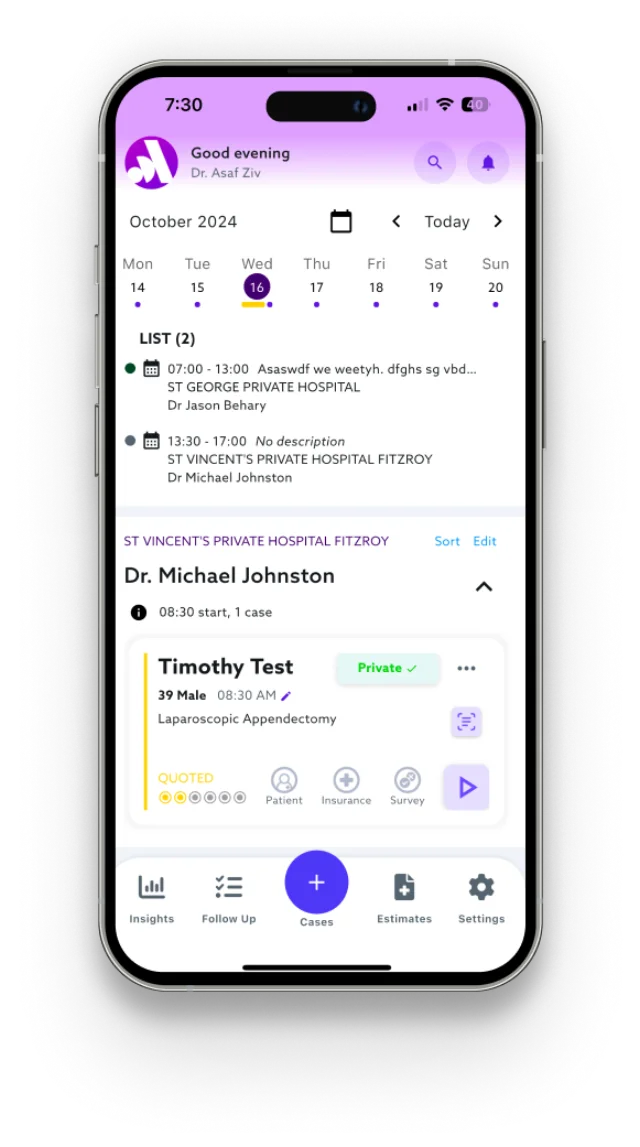
Create a complete case from a patient sticker, theatre list or mobile entry.
Quote
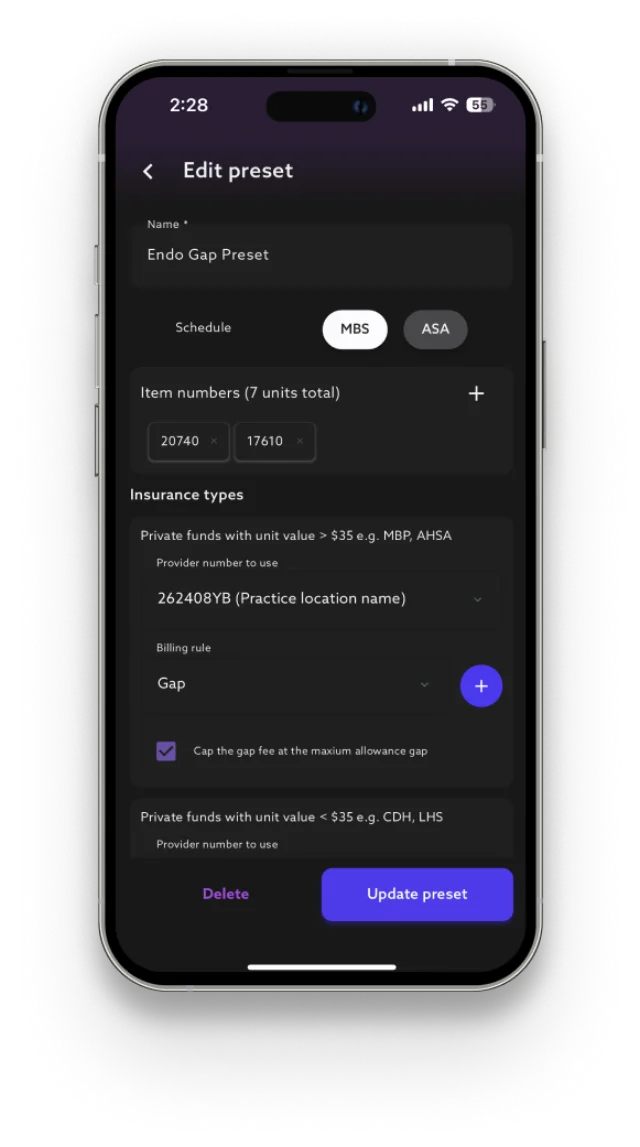
Apply the provider’s billing rules and issue clear informed financial consent.
Claim
Prepare and lodge claims through the appropriate Medicare and fund pathways.
Collect
Receive patient payments by bank transfer or card and maintain account visibility.
Reconcile
Match patient and payer receipts, adjustments and refunds to the correct account.
Understand
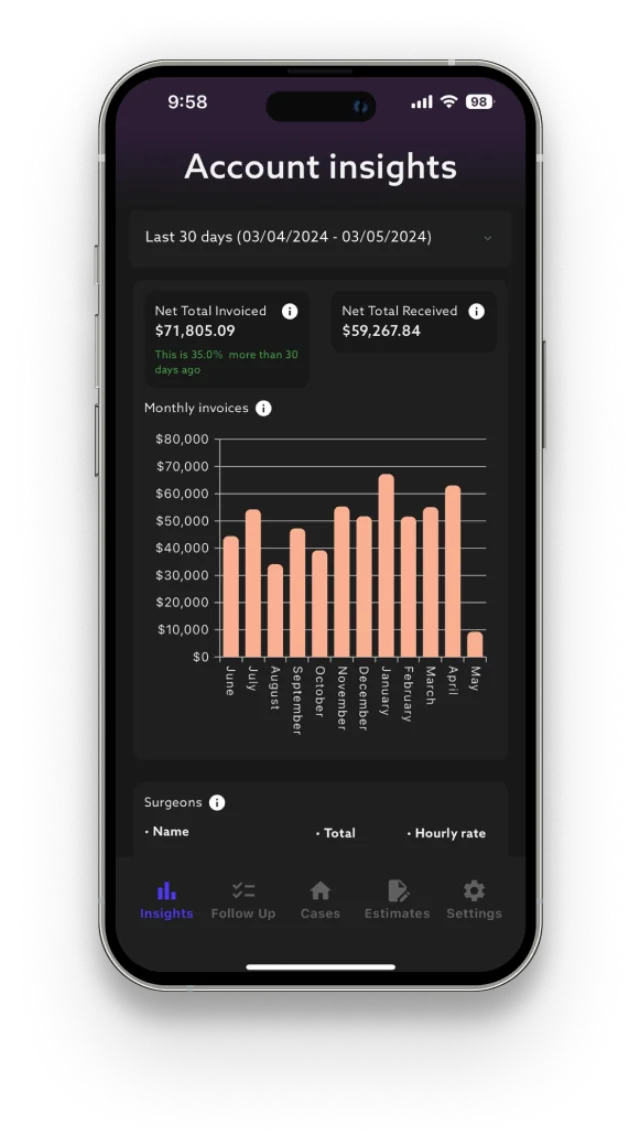
See what has been billed, received and remains outstanding without relying on spreadsheets.
One case, start to finish
One case. One connected financial record.
Capture reads the sticker, the provider’s rules price the case, eligibility and payer are confirmed, and the claim is lodged — without the details being re-entered between steps.
Capture
Sticker read on the phone
Validate
Eligibility and payer confirmed
Price
Your billing rules applied
Claim
Lodged via ECLIPSE
What changes
Less administration. Clearer finances. Control at every level.
01 — Administration
Stop re-entering the same case in three places.
A logbook, an email to a billing agent and a spreadsheet each hold part of the picture, and every hand-off between them is a chance for a case to be delayed or dropped. Anaemate removes the hand-offs: the record created at the point of care is the record that is quoted, claimed, collected and reconciled.
02 — Finances
Invoiced is not the same as collected.
Billed, received, outstanding, adjusted and refunded are five different figures, and a practice that tracks only the first does not know its position. Anaemate keeps them separate and reports on them by provider, list, surgeon and group.
03 — Control
Standardise the process without standardising every doctor.
Fee positions reflect a provider’s subspecialty and case mix, and forcing them to converge rarely survives contact with the providers concerned. Group policy governs how accounts are worked and what patients are told; individual billing preferences sit inside it.
Two ways people use Anaemate
Which one sounds like you?
Billing for yourself and billing for a group are different jobs, priced differently and usually run by different people.
Your billing, without the evenings.
You capture the case on your phone in theatre. Everything after that — the estimate, the consent, the claim, chasing what has not been paid — runs on rules you set once.
2% of your billings. Or 4% plus $129 a month for Premium, which adds a dedicated billing agent.
- Photograph the sticker
- The case is created from it. No logbook, no email to a billing agent.
- Set your fees once
- A unit value, a gap fee or a total fee. Applied to every case that matches.
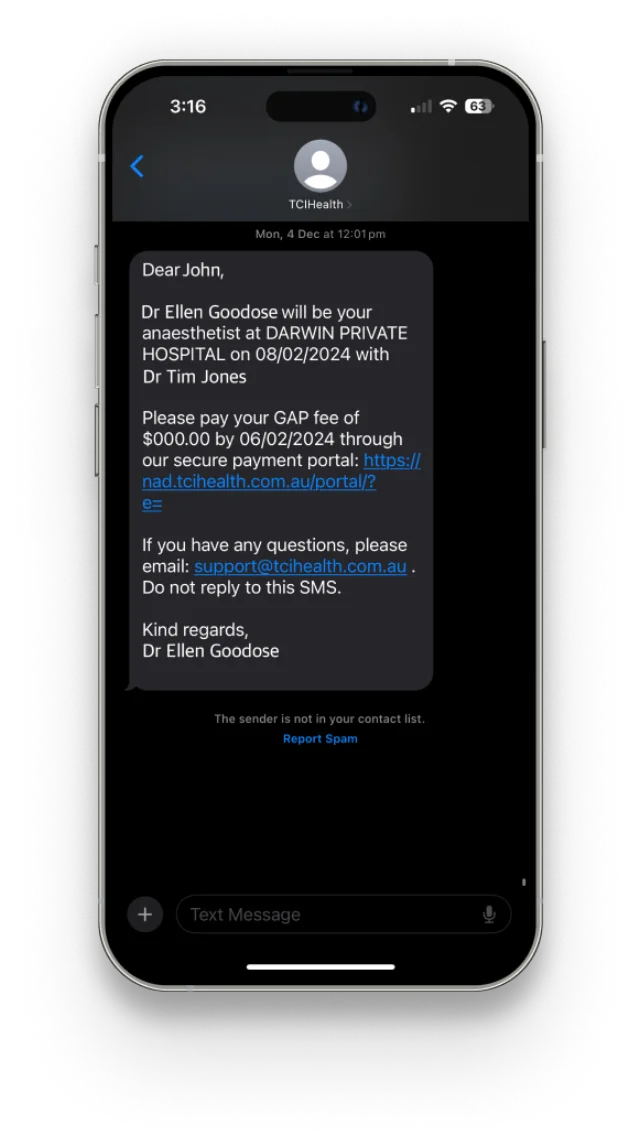
- Patients get a written estimate
- Sent automatically, with the wording informed financial consent needs.
- Claims go the same day
- Medicare, health funds, DVA, workers’ compensation and defence.
- Overdue accounts get chased
- Followed up properly, rather than quietly ageing.
- You can see what you earn
- By surgeon, by list, by date — including your hourly rate.
One operation, not six parallel ones.
Every doctor arrives with their own fee positions and their own habits, and administration absorbs the difference. Anaemate lets the group hold one process while each provider keeps their own billing preferences inside it.
A fixed fee per doctor per month, quoted after a conversation. Fixed rather than a percentage, so growing your billings does not raise what you pay.
- One place to administer everyone
- Providers, staff, permissions and templates, managed centrally.
- Doctors keep their own fees
- Group policy governs the process. It does not force one fee schedule.
- Work moves between staff
- Handover and alerts, so nothing sits in one person’s inbox.
- Reporting at both levels
- The group sees the whole picture. Each doctor still sees their own.
- Adding a doctor is configuration
- Not a new relationship with a billing agent.
- A record of who changed what
- Audit history, for when a query lands months later.
What it would cost
Work it out on your own numbers.
Every figure below comes from our published rates. There is no estimate of extra income, hours saved or claims recovered — just what you would pay, so you can hold it against what you pay now.
Set to 0% if you do your own billing. Most billing agents charge between 4% and 8%.
Worked out from published rates — 2% of billings, or 4% plus $129 a month on Premium. No assumption is made about extra income, time saved or claims recovered. Excludes GST and any card fees, which patients pay directly.
- Your billings a year
- $504,000
- Anaemate at 2%
- $10,080 a year
- About $840 a month.
- Anaemate Premium at 4% + $129 a month
- $21,708 a year
- $11,628 more than the standard plan. That covers a dedicated billing agent, a 1300 line for your patients and payments into your own bank account.
- Against your current 6%
- $20,160 less a year
- Compared with what you pay now, on the same billings.
Financial visibility
Know what was billed, what was paid and what remains outstanding.
Invoiced revenue and collected revenue are different numbers, and the gap between them is where private practice income is quietly lost. Anaemate keeps every state distinct so the difference is visible rather than inferred at the end of the year.
- Amounts billed
- By provider, list, surgeon and group
- Receipts
- Patient, Medicare and health fund payments
- Outstanding
- Aged accounts rather than a single total
- Adjustments
- Refunds and corrections against the original account
- Reconciliation
- Receipts matched to accounts and to the bank
- Reporting
- BAS and end-of-financial-year outputs
Reporting supports financial management. It does not replace professional accounting advice.
The patient
Clearer information before the procedure.
An anaesthetic fee cannot always be fixed before surgery, because it depends in part on how long the procedure takes. Anaemate produces an estimate from the available payer information, the item numbers and the provider’s configured billing rules, and issues it in writing with the reasons the final account may differ.
The estimate, the consent and the full communication history stay attached to the case, so what a patient was told and when remains answerable months later. Payment can then be made through supported digital pathways.
Service model
Operate the platform yourself, or have our team manage the process.
Platform model
The practice runs its own billing
Your team captures cases, applies billing rules, lodges claims and works outstanding accounts in Anaemate. You hold the process and the reporting.
Managed billing
Our team operates it with you
TCI Health’s billing team supports or operates agreed parts of the process. The practice keeps the same visibility of billing status, outstanding accounts and reconciliation throughout — it is not an outsourced black box.
Responsibilities, communication and reporting are agreed in writing at the outset, and reviewed as the practice changes.
Security and governance
Healthcare information deserves operational discipline.
Anaemate holds health information regulated under the Privacy Act 1988 and the Australian Privacy Principles, alongside the financial records of the practice. The security page is written for the people who assess it — a practice manager, a privacy officer or an enterprise security reviewer — and states each control area and its current position.
- Australian Privacy Principles
- Role-based access
- Multi-factor authentication
- Encryption in transit and at rest
- Device and session controls
- Audit history
- Backup and continuity
- Incident management
- Vendor governance
- Security testing
- Data location and retention
- Enterprise security review
Getting there
A structured path from your current process to Anaemate.
An individual anaesthetist can be operating quickly. A group carries open accounts, established fee positions and staff whose daily work is about to change — that is an operational change, not an account creation.
Discovery
How the practice bills today and what a migration must preserve.
Configuration
Providers, billing rules, templates and permissions.
Data preparation
What transfers, what is archived, how both systems run in transition.
Training
Delivered by role, because each role works on a different surface.
Go-live
Staged, so an issue affects one group rather than the whole practice.
Adoption and support
Confirming the workflow is used as designed rather than assuming it.
The company
Built by TCI Health.
TCI Health is an Australian medical technology company focused on improving the operational and financial infrastructure of private healthcare. Anaemate was developed in close collaboration with anaesthetists and practice teams who understand the complexity of billing, patient communication and practice administration.
The company is Australian owned and operated, and implementation and support are provided locally by people who work with anaesthetic practices rather than general medical billing.
Next step
See how Anaemate would work in your practice.
Talk through your current billing process, administrative structure and financial reporting requirements with our team.