Capture to lodgement
Billing and claims
Cases enter the system where they happen — in theatre — and are priced by rules configured once, then lodged through ECLIPSE. Claims can be submitted on the day of the procedure.
The problem this solves
Anaesthetic cases do not arrive as structured records. They arrive as a patient sticker on a page, or as a theatre list emailed the night before. Turning that into a lodged claim traditionally means a logbook, an email to a billing agent, and a delay of days or weeks before anything reaches Medicare.
Every hand-off in that chain is a point where detail is transcribed, and every transcription is a chance to introduce the error that causes a rejection weeks later — at which point the case is cold and the correction is expensive.
Capture without re-keying
Photograph a patient sticker with the phone camera and the record is created from it. Import a theatre list and multiple records are created at once. Details can be corrected from the mobile app or the web dashboard before anything is lodged.
- Sticker recognition from the mobile camera
- Theatre-list import for a whole session
- Correction from either mobile or web
- Removes the logbook and the email to a billing agent
Validate before you quote
Eligibility is confirmed as part of capture, so cover and payer are established before an estimate is issued rather than discovered after the account is raised.
- Patient eligibility confirmed at capture
- Payer identified — fund, Medicare, DVA, workers’ compensation or defence
- Missing details surfaced before lodgement, not after rejection
Billing rules applied consistently
Rules define how a case is priced before it reaches the billing step. Set a unit value, a gap fee or a total fee, and apply it to a whole list or to an individual case. The same rule produces the same price every time, which is what makes pricing predictable across a practice.
- Unit value, gap fee or total fee
- Applied to a list or to a single case
- Consistent pricing across providers in a group
Claiming and payers
Claims are lodged to Medicare and private health funds through ECLIPSE. Workers’ compensation, DVA and defence claims are supported, as is public-in-private claiming.
- Medicare and private health funds via ECLIPSE
- Workers’ compensation, DVA and defence
- Public-in-private claiming (1% fee plus GST)
- Same-day submission
Audit trail
What was billed, under which rule, by whom and when is retained against the record — which is what makes a query answerable months later without reconstructing it from memory.
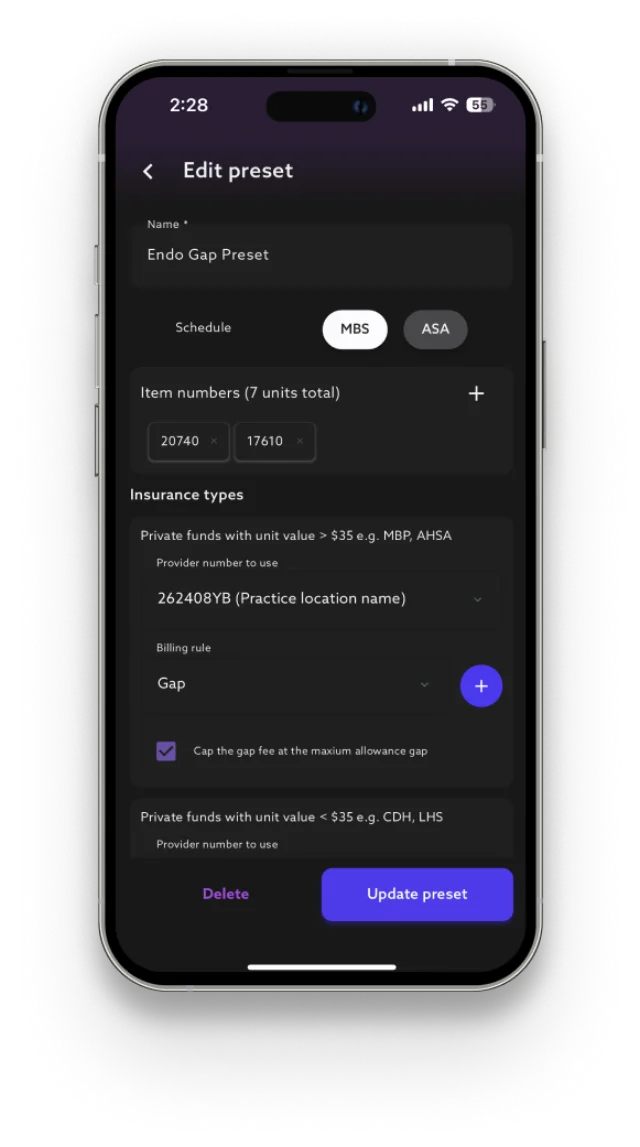
Reading this screen
- What you are viewing
- The billing presets screen, where pricing rules are defined.
- Who uses it
- Configured by the anaesthetist or practice manager.
- What it supports
- Setting a unit value, gap fee or total fee before cases are billed.
- What happens next
- Rules apply automatically to cases as they are captured.
Who does what
The same record, seen differently by each role
Anaesthetist
Captures the case in theatre and confirms the item numbers.
Billing staff
Reviews exceptions, lodges claims and works rejections.
Practice manager
Sets billing rules and monitors lodgement across providers.
Next step
Talk through how your practice bills today
A consultation covers how cases are captured, how quotes and consent are handled, where accounts are being lost, and what moving to Anaemate would involve for your practice or group.